

XR Experiences (AR/VR/MR)
How Virtual Reality Is Revolutionizing Medical Training


 AI Summary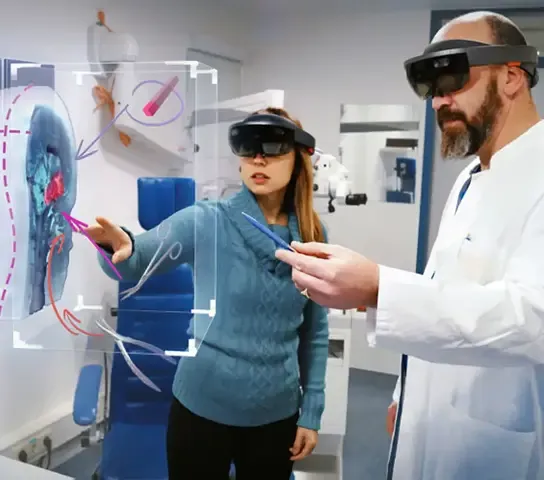
Virtual Reality in Medical Education
Virtual reality in medical education is reshaping how the next generation of doctors, nurses, and healthcare professionals learn critical skills. By integrating immersive VR simulations into classrooms and clinical programs, institutions are bridging the gap between theory and real-world application. Instead of relying only on traditional labs or limited patient exposure, learners can now practise procedures, diagnose virtual patients, and collaborate in safe, hyper-realistic environments.
The global VR healthcare training market is projected to reach over USD 16 billion by 2030, growing at a CAGR of 25 %. This surge highlights the increasing demand for effective, scalable VR training solutions in medical institutions worldwide. As pioneers in immersive technology, Narsun Studios empowers organizations to adopt cutting-edge virtual reality medical training platforms tailored to real-life clinical needs.
Why Virtual Reality in Medical Education Matters
The rise of virtual reality in medical education is transforming how healthcare professionals are trained. Unlike traditional classrooms or limited real-patient exposure, immersive VR environments offer realistic, repeatable, and data-driven learning experiences that boost skill development and confidence.
Here's why it matters:
- Safe and Controlled LearningTrainees can practise complex procedures and interact with virtual patients without any risk to real lives.
- Mistakes become opportunities to learn rather than critical errors.
- Studies show that virtual reality medical training leads to a 230% performance improvement in complex tasks compared to traditional methods.
- Faster Skill AcquisitionA PwC study revealed that learners in VR training programs complete courses four times faster than classroom learners.
- Realistic simulations accelerate muscle memory and procedural understanding.
- Consistency Across LearnersVR healthcare training delivers standardized lessons and assessments to large groups, ensuring uniform quality.
- Institutions can simulate rare medical conditions or emergencies on demand, something traditional setups can't easily replicate.
- Improved Engagement and RetentionImmersive learning environments improve focus and retention by up to 75%, compared to passive methods like lectures.
- Interactive learning keeps students more motivated and invested.
- Cost and Resource EfficiencyVirtual reality medical training reduces dependency on physical labs, cadavers, and material costs.
- Over time, virtual simulations prove more scalable and budget-friendly for universities and hospitals.
- Real-World ReadinessLearners graduate with higher confidence and decision-making ability, ready for high-stakes clinical environments.
- Hospitals using immersive VR report improved onboarding and lower training-related errors.
Key Applications of Virtual Reality in Medical Education
The potential of virtual reality in medical education extends across multiple disciplines and use cases. From surgical simulations to patient communication, VR healthcare training enhances every layer of the learning experience. Here's how educators and hospitals are using immersive VR to transform medical training today:
- Surgical Simulation and Procedural PracticeTrainees can perform complex surgeries in a realistic 3D environment, using VR training modules that mirror actual tools and movements.
- These simulations help medical residents refine techniques, reduce stress, and improve precision before operating on real patients.
- Research shows 83 % of surgeons trained with virtual reality medical training performed better in operating rooms than those trained traditionally .
- Interactive Virtual PatientsVirtual patients simulate emotional responses, symptoms, and feedback helping learners practise diagnosis, empathy, and communication.
- This bridges the gap between clinical theory and bedside manner.
- According to Frontiers in Virtual Reality, VR simulations improve diagnostic accuracy by 40% among trainees.
- Team and Emergency Response TrainingHealthcare is teamwork, and immersive VR allows multi-user environments where nurses, doctors, and support staff coordinate during high-pressure scenarios.
- Teams can rehearse emergency protocols, cardiac arrests, trauma care, or mass-casualty incidents, without needing physical labs.
- A HealthTech Magazine study reported that VR healthcare training improved team communication by 32%
- Anatomy and Physiology EducationMedical students can explore detailed 3D models of the human body, interact with organs, and visualize internal systems dynamically.
- Virtual reality in medical education replaces static textbook diagrams with interactive exploration, improving long-term retention.
- Harvard Health Publishing reports VR anatomy learners scored 20% higher in visual-spatial understanding.
- Patient Education and Therapy SupportHospitals use VR training tools to help patients understand their conditions, treatments, and recovery paths.
- Interactive visuals reduce anxiety and enhance engagement during rehabilitation and wellness programs.
- Narsun Studios delivers these immersive solutions through its Healthcare Industry Services, enabling hospitals to adopt patient-centric XR experiences.
Benefits of Using Virtual Reality in Medical Education
Implementing virtual reality in medical education has transformed how future doctors, nurses, and surgeons learn, practice, and refine their skills. Below are some of the most impactful benefits:
- Realistic and Immersive Learning
Immersive VR provides an authentic, 3D simulation of clinical settings, from operating rooms to emergency wards. Students can interact with virtual patients and medical instruments just like in real life, helping bridge the gap between theory and practice.
- A study by Harvard Business Review found that learners trained with VR healthcare training were 275% more confident in applying their skills afterward.
- Safe Environment for Trial and Error
In VR training, mistakes become learning opportunities without real-world consequences. Students can perform complex surgeries repeatedly, mastering procedures without endangering patients.
- Cost-Effective Medical Training
Hospitals and institutions save on expensive cadavers, lab setups, and equipment by adopting virtual reality medical training. Once developed, VR modules can be used by thousands of students simultaneously.
- Standardized Education Across the Globe
Virtual reality in medical education ensures consistent training experiences worldwide. Whether in Dubai, London, or Karachi, students can access the same level of high-quality, guided practice.
- Improved Retention and Engagement
VR enhances focus and memory retention. According to a PwC report, trainees using immersive VR learned four times faster and were 3.75 times more emotionally connected to the content compared to traditional classroom learners.
- Remote Learning Possibilities
Virtual classrooms enable learners from any location to participate in medical training simulations. This flexibility supports global collaboration and continuous education, even across time zones.
Real-World Examples and Case Studies
The use of virtual reality in medical education is no longer experimental, it's already shaping the future of healthcare training across leading institutions worldwide.
- Cleveland Clinic and Case Western Reserve University
Cleveland Clinic and Case Western Reserve launched HoloAnatomy, a VR healthcare training platform that replaces traditional cadaver dissection with 3D anatomy exploration. This approach helps students visualize complex systems with clarity impossible in standard labs.
- Stanford Medicine's Virtual Reality Lab
Stanford's Immersive Learning Center integrates virtual patients into surgical simulations, letting medical students and residents practice procedures and soft skills such as empathy and patient communication.
- Oxford Medical Simulation
The Oxford Medical Simulation platform allows healthcare professionals to engage in realistic, high-pressure clinical situations using immersive VR. This model has been adopted in over 40 hospitals across the UK and US, improving both reaction time and teamwork in emergency settings.
- Johns Hopkins University
Johns Hopkins introduced a VR training module for spinal surgery that allows residents to repeatedly practice delicate procedures. Their studies show improved accuracy and faster completion times among trainees compared to traditional methods.
- Narsun's Contribution to VR Medical Training
At Narsun Studios, our team has been at the forefront of developing virtual reality medical training environments for hospitals and education centers. Our solutions replicate real clinical scenarios, from patient diagnosis to surgical simulation, providing institutions with scalable, data-driven ways to assess and train healthcare professionals.
The Future of Virtual Reality in Medical Education
The next phase of virtual reality in medical education is set to be even more transformative as new technologies merge with immersive learning. Here's a glimpse into what's ahead:
- Integration of Artificial Intelligence
AI will personalize VR healthcare training by analyzing student performance, identifying weak areas, and tailoring future sessions for improvement. Imagine virtual patients that respond dynamically to a learner's decisions, creating truly adaptive learning experiences.
- Haptic Feedback and Sensory Realism
Advancements in haptic technology will make immersive VR even more lifelike. Medical trainees will not only see virtual organs but feel them, understanding texture, pressure, and resistance as they perform virtual surgeries.
- Global Access and Remote Collaboration
As VR headsets become more affordable, virtual reality medical training will expand beyond elite universities. Students in remote areas will gain equal access to premium medical training tools, reducing educational inequality worldwide.
- According to Grand View Research, the global VR in healthcare market is projected to reach $16.2 billion by 2030, growing at a CAGR of 26.6%.
- Data-Driven Learning Analytics
Institutions will increasingly rely on analytics from VR training modules to measure skill progression and competence objectively, replacing subjective assessments with real performance data.
- Collaboration Between Tech and Medicine
Partnerships between med schools, hospitals, and VR developers like Narsun Studios will shape the future of immersive learning, designing simulations that continuously evolve with real-world healthcare needs.
Conclusion
Virtual reality in medical education is transforming how doctors and students learn. By combining realistic VR training, virtual patients, and immersive simulations, it delivers hands-on experience in a safe, repeatable environment.

 3 min read
